Mini Goldendoodle: A Complete Guide
I’m Amy Lane, and I created the Mini Goldendoodle at Fox Creek Farm back in 1999. Since then I’ve also founded the Goldendoodle Association of North America (GANA) to help set breed standards for the whole industry. If you’re researching a Mini Goldendoodle for your family, these 21 characteristics cover everything I’ve learned over 25+ years: size, generations, coat, temperament, health testing, and what you should expect to pay for a puppy from a reputable breeder.
1. What They Are
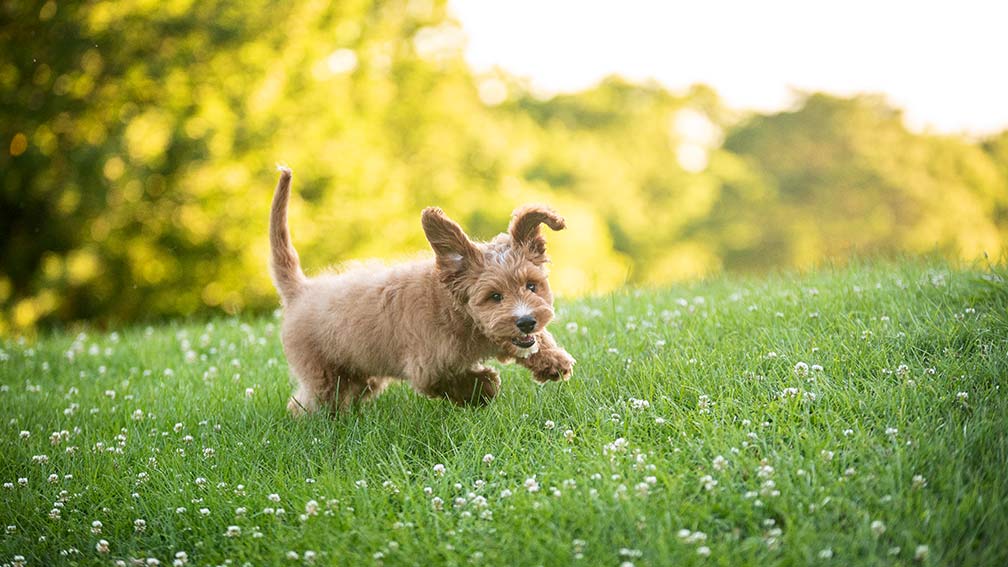
The Mini Goldendoodle is a mixed breed produced by crossing a Miniature Poodle with a Golden Retriever. The F1 standard Goldendoodle was the first generation ever bred, a direct cross between a standard Poodle and a Golden Retriever. From there, breeders like me worked to bring the size down while keeping the low-shedding coat, the intelligence, and the temperament that make the breed so beloved. Today’s Mini Goldendoodle typically weighs 25 to 45 pounds, with most puppies shedding very little.

2. Reputable Breeders
Mini Goldendoodle breeders can be accredited by the Goldendoodle Association of North America, which I founded to hold breeders to consistent health and temperament standards. GANA-accredited breeders health test every dog before breeding, covering hips, elbows, heart, patella, and eyes, and commit to producing puppies with sound temperaments and predictable coats.
3. Breed Standard
Knowing the GANA breed standard before you start your search helps you tell an ethical breeder from one that isn’t. The standard covers general appearance, size and proportion, temperament, and overall health measures, and every dog bred to it is evaluated against these criteria before ever being paired.
4. Generations
Understanding Mini Goldendoodle generations helps you know exactly what you’re bringing home.
F1 Mini Goldendoodle: the first-generation cross between a Miniature Poodle and a Golden Retriever, a 50/50 genetic split.
F1B Mini Goldendoodle: an F1 bred back to a Miniature or Toy Poodle, which increases the Poodle percentage to roughly 75/25 and improves coat predictability for allergy-sensitive families.
Multigen Mini Goldendoodle: the result of breeding two Mini Goldendoodles together over several generations. Multigen puppies with two furnishing genes are the most likely to be truly non-shedding, regardless of coat type.
5. Size and Growth
A Mini Goldendoodle stands 14 to 17 inches at the shoulder and generally weighs 26 to 35 pounds as an adult, compared to a standard Goldendoodle‘s 51 pounds or more. Weight can vary depending on the parents and the individual puppy, so any number a breeder gives you before 8 weeks is an educated estimate, not a guarantee.
6. Coat Colors
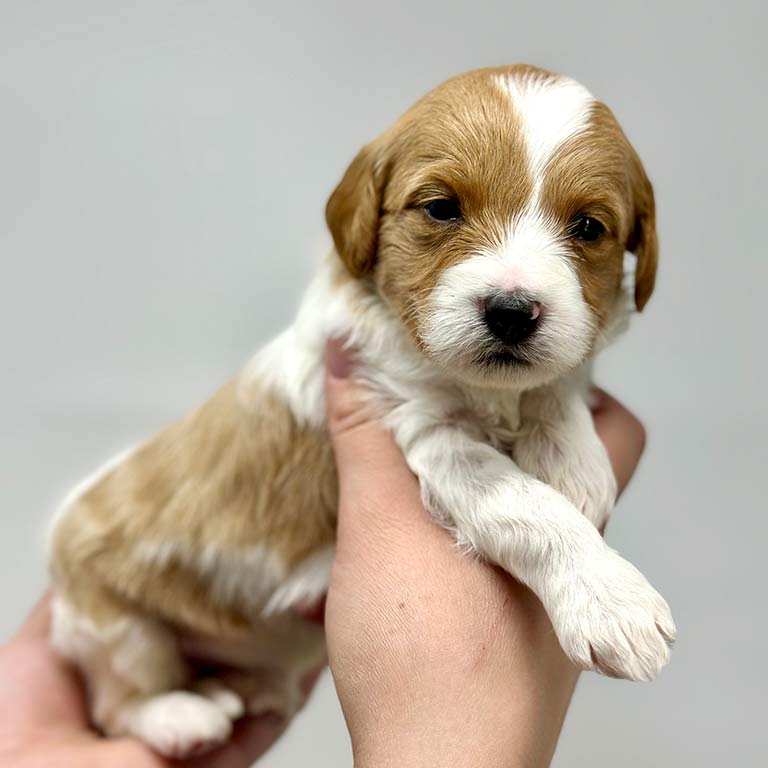
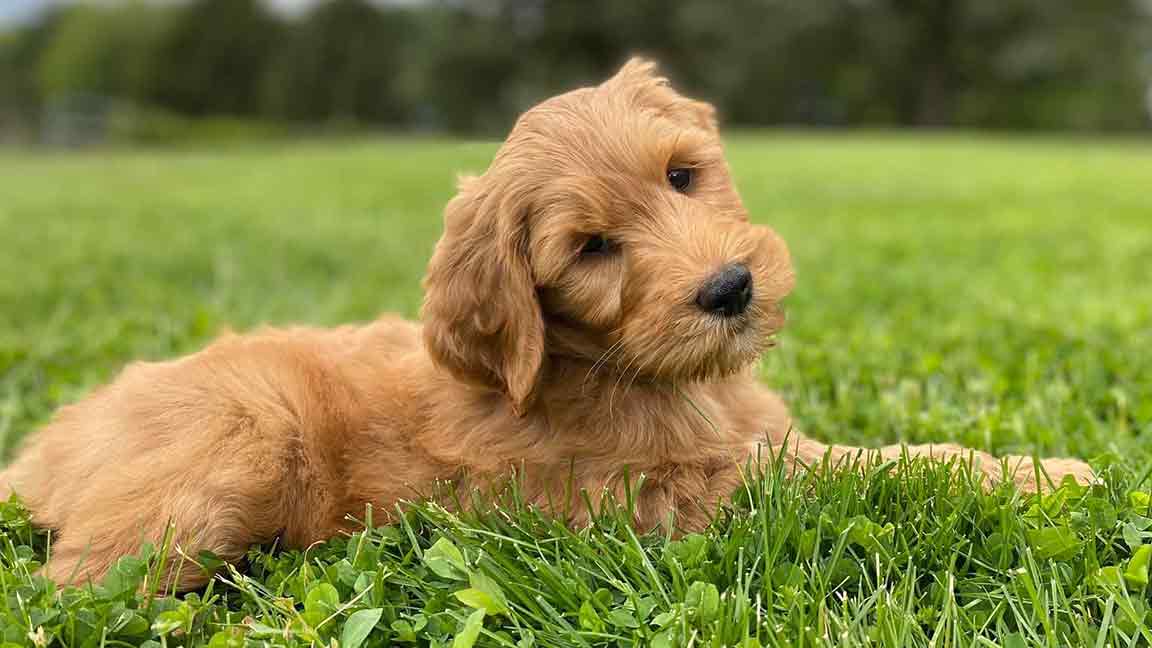
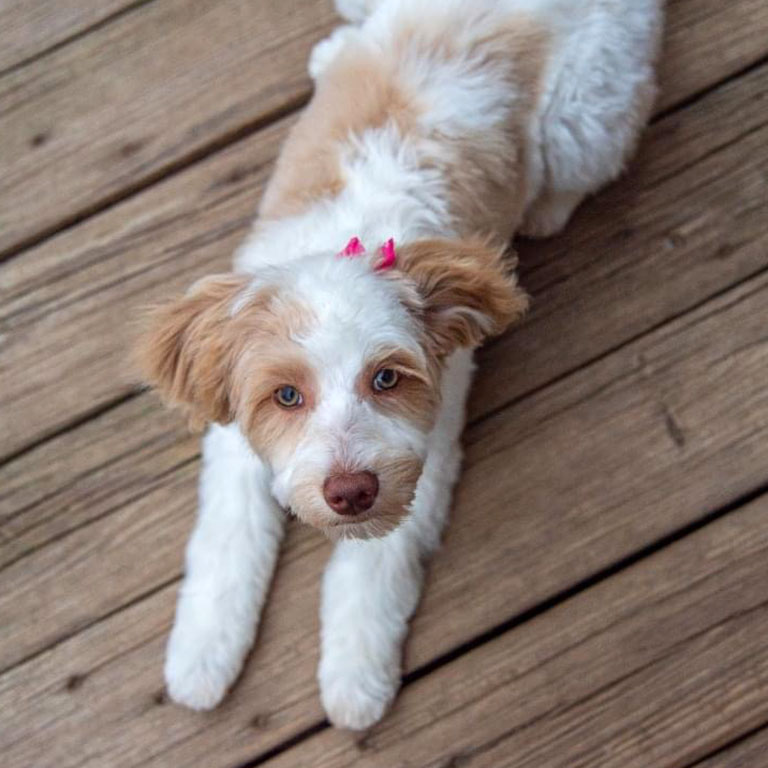
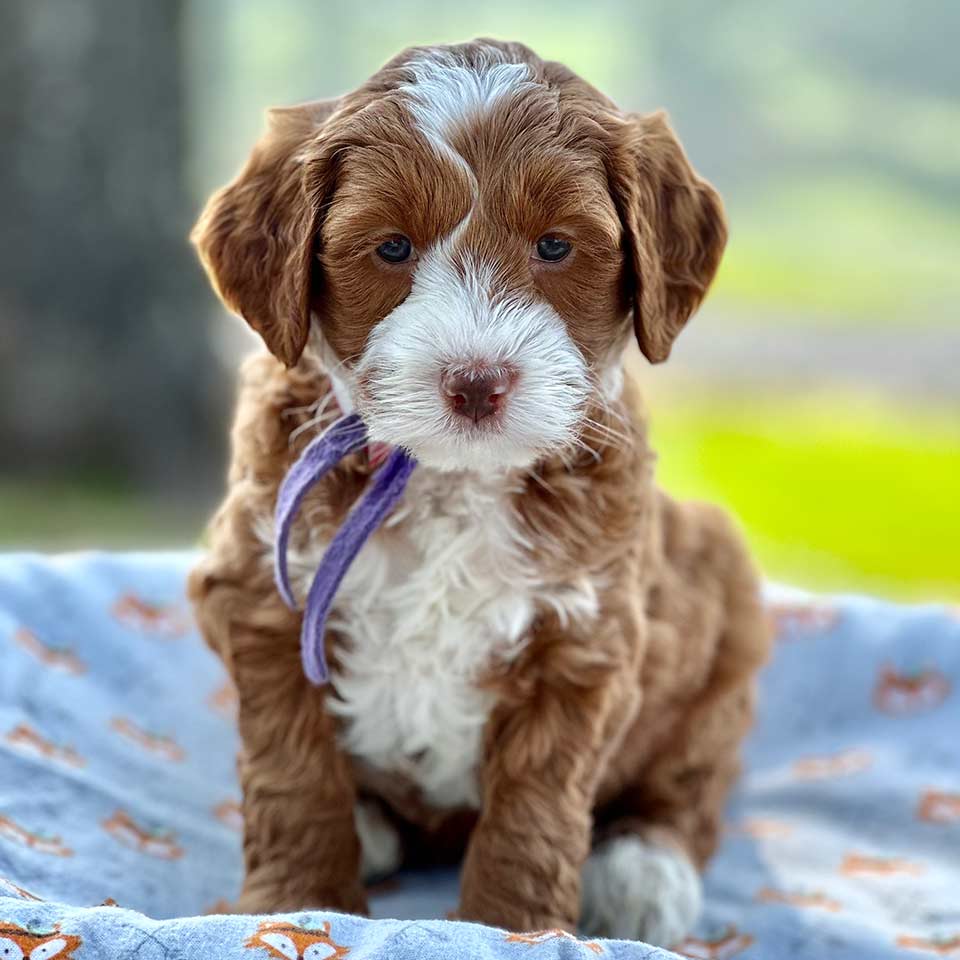
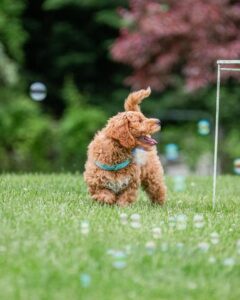
The Mini Goldendoodle comes in a wide range of colors, and the parents’ genetics play the biggest role in what a litter produces. You’ll see solid shades from cream and gold to red, black, or chocolate, along with multi-color patterns. Parti-colored puppies are more than 50% white with solid patches. Tuxedos have white chests, paws, and a blaze on the face. Merle, phantom, and tri-color patterns also show up in the breed, and I always test my breeding pairs to confirm safe, healthy color combinations before pairing them.
7. Coat Types
Every Mini Goldendoodle puppy carries different coat genetics. Depending on the KRT71 gene, a coat can be straight, wavy, or curly, and it can run short or long, depending on the parents’ alleles. Furnishings, the longer facial hair around the muzzle and brows, are the other big variable. Puppies with furnishings tend to shed the least; puppies with an “open face” and shorter facial hair shed more. With DNA testing, reputable breeders can now predict coat outcomes far more reliably than we could even a decade ago.
8. Suitable Homes
A Mini Goldendoodle’s smaller footprint makes it a great fit for apartments and smaller homes, since it doesn’t need the space a standard-size dog would. They’re not meant to be inside exclusively, but their size lets them settle comfortably into smaller living spaces as long as they still get daily exercise and playtime.
9. Family Temperament
Mini Goldendoodles are known for being patient, affectionate, and easy to be around, which is exactly why they’ve become such popular family dogs. They’re highly intelligent and quick to pick up new behaviors with positive reinforcement, and most families find a lot of their basic training can happen at home.
10. Activity Level
Energy levels vary from dog to dog, and factors like lack of exercise or too much crate time can drive up hyperactivity regardless of breed. Daily structured playtime or a walk keeps a Mini Goldendoodle’s naturally happy energy in balance, and once puppies are fully vaccinated, socializing them with other dogs builds confidence too.
11. Therapy and Service Potential
Many Mini Goldendoodles go on to become excellent therapy or service dogs. Their sociability and trainability make Canine Good Citizen and Therapy Dogs International certification very achievable, while service dog work typically requires additional professional training.
12. Hybrid Vigor
Mini Goldendoodles benefit from hybrid vigor, the improved health that comes from crossing two genetically distinct breeds rather than breeding within a single closed line. At Fox Creek Farm, I never cross related lines within three previous generations, so that benefit isn’t lost as I continue producing Mini Goldendoodles.
13. Health Testing
Health testing is the single biggest factor separating a reputable Mini Goldendoodle breeder from a backyard breeder, and it’s something I take seriously with every litter. At Fox Creek Farm, every breeding dog goes through:
- PennHip evaluation
- OFA testing for hips, elbows, heart, and patella
- OFA eye certification
- DNA panel testing for breed-specific inherited diseases
14. Lifespan
A well-bred Mini Goldendoodle typically lives 12 to 15 years. Like any breed, they can be prone to hip dysplasia or eye conditions if the parents weren’t properly screened, which is exactly why health testing matters so much before you ever meet a puppy.
15. Crate Training
Crate training should start early and build gradually. Confining your puppy to a crate when unsupervised prevents accidents and teaches them to control the urge to eliminate. As a general guide, start with about three hours in the crate before a potty break, and add roughly one hour for every month of age as your puppy matures.
16. Non-Shedding Coat
Most Mini Goldendoodles shed very little thanks to their Poodle heritage, and that low-shedding trait comes down to furnishing genes rather than curl alone. Puppies with two copies of the furnishing gene, confirmed through DNA testing, are the most reliably non-shedding regardless of whether their coat is straight, wavy, or curly.
17. Grooming
Because of their coat, Mini Goldendoodles need daily brushing with a slicker brush and a metal comb to prevent matting, along with monthly nail trims and regular teeth brushing. Bathe only as needed with a tearless shampoo so you don’t dry out the coat. None of this makes a Mini Goldendoodle harder to groom than any other long-coated breed, it just needs a consistent routine.
18. Puppy Culture
The best Mini Goldendoodle breeders use enrichment programs like Puppy Culture during the first weeks of a litter’s life, covering early socialization, anti-aggression protocols, and problem prevention before a puppy is ever placed with its new family. At Fox Creek Farm, every litter goes through this program from birth.
19. An Even Smaller Size
If a Mini Goldendoodle still sounds bigger than what you need, I also breed an even more compact size for families who want everything this breed offers in a smaller package. These puppies typically weigh 10 to 25 pounds and stand under 14 inches, making them a great fit for apartments, seniors, or anyone who wants a dog that travels easily. My full micro mini Goldendoodle guide walks through generations, size expectations, and health testing for that smaller size in detail.
20. Price
Mini Goldendoodle puppies from health-tested, reputable breeders typically range from $2,500 to $4,500 nationally, depending on the breeder’s reputation, health testing, location, and the puppy’s coloring. At Fox Creek Farm, Mini Goldendoodle puppies are $4,000, which reflects full PennHip and OFA testing, DNA panel testing, and our Puppy Culture socialization program from birth. If you see a Mini Goldendoodle priced well below market, ask hard questions about health testing before you commit. And skip puppy brokers entirely; you should know your breeder and be able to build a real relationship with them.
21. First Steps
A quality Mini Goldendoodle comes from parents tested and certified clear of hip, elbow, heart, eye, and patella issues. Because temperament, size, and gender can’t be fully predicted before birth, I match puppies to families based on your household and lifestyle, usually around 8 weeks of age.

Frequently Asked Questions
What is a Mini Goldendoodle?
A Mini Goldendoodle is a crossbreed between a Golden Retriever and a Miniature Poodle, producing a smaller, low-shedding version of the classic Goldendoodle with the same friendly temperament.
How big do Mini Goldendoodles get?
A Mini Goldendoodle typically weighs 26 to 35 pounds and stands 14 to 17 inches tall, though size can vary depending on the parents.
Are Mini Goldendoodles hypoallergenic?
No dog is completely hypoallergenic, but a Mini Goldendoodle’s Poodle-influenced coat sheds very little, which makes it a common choice for allergy-sensitive families.
How much does a Mini Goldendoodle cost?
Mini Goldendoodle puppies typically range from $2,500 to $4,500 depending on the breeder, with health-tested lines like Fox Creek Farm’s priced at $4,000.
Do Mini Goldendoodles bark a lot?
Mini Goldendoodles aren’t typically excessive barkers. They may alert bark occasionally, and consistent training keeps this well in check.
Do Mini Goldendoodles shed?
Most Mini Goldendoodles shed very little thanks to their Poodle heritage, especially puppies with two furnishing genes confirmed through DNA testing.
How long do Mini Goldendoodles live?
A Mini Goldendoodle typically lives 12 to 15 years, with lifespan closely tied to health testing, diet, and overall care.
Do Mini Goldendoodles like to snuggle?
Yes, Mini Goldendoodles are affectionate by nature and genuinely enjoy staying close to their people.
Are Mini Goldendoodles good with children?
Yes, a well-bred, well-socialized Mini Goldendoodle is typically patient and gentle with kids, making it a strong fit for families.
What health issues should I watch for?
Hip dysplasia and eye conditions are the main concerns in the breed, both of which are largely preventable through PennHip, OFA, and DNA testing of the parents.


















We are by appointment only for the safety and health of our puppies.
Fox Creek Farm Goldendoodles
Hours:
Monday – Saturday – 9:00am-5:00pm
Sunday – Closed
Email:
info@goldendoodles.net
Phone:
Phone: 304-521-1885
Address:
Fox Creek Farm Goldendoodles
740 Mauzy Rd
Berkeley Springs, WV 25411
Website:
goldendoodles.net